Richard Wilson is one of Britain’s most respected and challenging contemporary artists. He is internationally celebrated for his interventions in architectural space which draw heavily for their inspiration on architecture, engineering and construction.
He has made some of the most memorable and arguably the best “outside†works of recent years. This is opposed to public art, which Wilson thinks has connotations of something second rate that is situated in municipal parks. All of Wilson’s work builds upon its context through surprise, incongruity, humour and a pervasive sense of unease. He questions the relationship between materials and construction, and deliberately confuses the viewer through juxtaposing one element against another in an unconventional manner. Probably his most memorable sculpture was “Turning the Place Overâ€. This sculptural intervention was created in Liverpool in 2008, during their tenure as City of Culture. Here Wilson cut an oval shaped section from the façade of a disused office building, this piece was then attached to a pivoting rod which revolved. The cut section was then returned to the facade. The revolution was not quite true to the building, so the sectional piece as it turned, appeared to float free from the façade before settling back into its original position. This created a sense of surprise, relief and then recognition among the viewers. Another dramatic artwork is 20:50, a permanent installation in the Saachi Gallery, London. A huge one-meter high tank was installed in one room of the gallery, and this was is filled with pure black sump oil, the sort that is recycled from car engines, indeed this is where the title of the piece comes from. A slanting walkway was constructed which allows the visitor to walk into the centre of the tank, and thus is invited to contemplate the highly reflective surface of the oil, the relationship between the oil and the ceiling and the unnerving beauty of the repulsive material. It could be argued that Wilson is working in a tradition of changing the perception of a building by altering it; from the picturesque follies of the 18th century, through Gordon Matta Clark’s cut buildings to Rachel Whiteraed’s castings. This alteration disorientates the viewer, thus asking questions about perception, understanding and commonly held views.
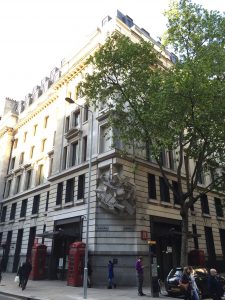
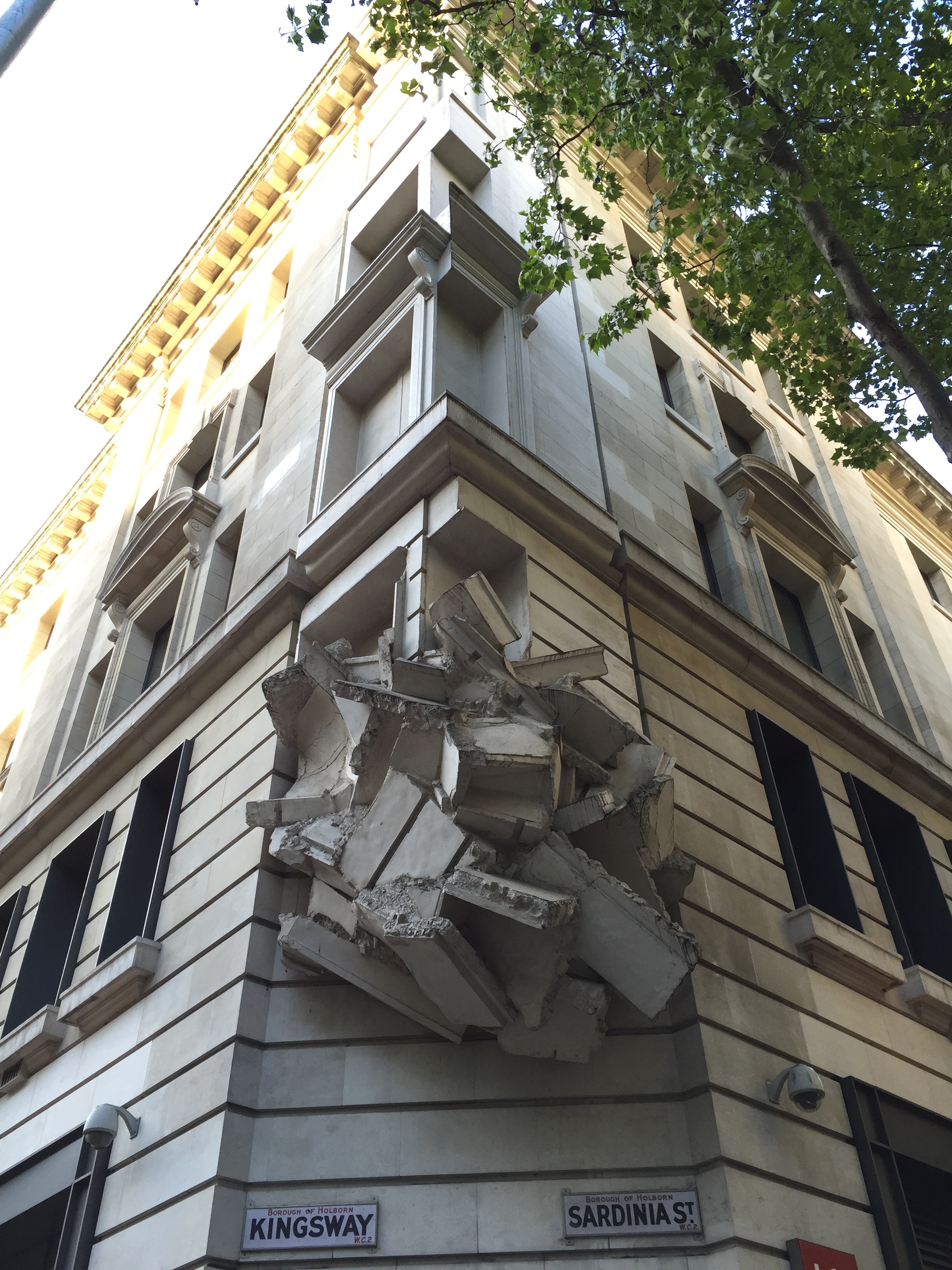
Square the Block (2009) is a major architectural intervention, which has been installed on the corner of one of the London School of Economics’ most prominent buildings. The sculpture appears to an abstraction of the corner that both mimics and subtly subverts the existing façade of the building. The stonework looks as if it has been jumbled and crumpled up, then just reattached to the building. It deliberately upsets the perception of the building from something quietly solid and dignified into something unsettling and fallible.
The corner of the building was actually originally chamfered, this allowed Wilson to construct elements that projected from it. Then to construct the artwork, the artist, working with engineers Eckersley O’Callaghan, created copies of a number five-storey vertical slices from the neighbouring buildings. Moulds were taken from these and the resultant casting fixed to a three-dimensional aluminium truss , which was six storeys in height and approximately triangular. The pieces of the sculpture were constructed from a water-based acrylic composite: Jesmonite. This was selected because it was economical to produce, light enough to be carried by the existing building structure and had a close visual match to the Portland stone cladding. The completed sculpture assembled on the ground and the complete piece lifted into place. It was hung on the side of the building from the fifth floor only and tied back to the building at second and sixth floors for stability.
The sculpture makes no architectural and functional sense other than matching the cornice work and completing the corner. Its position means that it is sometimes unnoticed, overlooked and therefore the moment of incongruity and recognition is often delayed and thus amplified. It is an intervention that both mimics and subtly subverts the existing facade of the building.